CONSISTENT EMISSIONS DATA FOR DIRECT USE OF SOLD PRODUCTS
Direct-Use Product Emissions Database
VERSION 3 NOW AVAILABLE
Developed with input from:







Align your downstream scope 3 emissions calculations
Fill reporting gaps, measure consistently, and report your scope 3, category 11 emissions with confidence. Developed in collaboration with the Retail Industry Leaders Association (RILA), the Direct-Use Product Emissions Database (DPED) combines input from leading retailers and expertise from industry, government, and non-profit organizations.
With emissions data for over 600+ consumer and commercial product categories, the DPED provides consistent and comparable scope 3 emissions data for your annual reporting.
INDUSTRY LEADING EXPERTISE
Developed by leading retailers and industry experts
The DPED is developed annually via a strategic partnership between RILA and Green Project and is guided by input from leading retailers — including Lowe’s, Target, Wayfair, and Williams-Sonoma Inc. – and an ex officio committee of industry and regulatory leaders including the European DIY Retail Association (EDRA)/Global Home Improvement Network (GHIN), and Retail Council of Canada (RCC).
RELIABLE PRODUCT-USE DATA
Emissions data for 600+ product types
To set climate goals and report reliably, retailers need access to the best available assumptions for how customers use energy-consuming products. The DPED solution provides emissions data for over 600 product types, including classifications across:
- Accessible Home: Speakers, smart lights, smart thermostats, etc.
- Appliances: Refrigerators, cooktops, microwaves, etc.
- Chemicals: Refrigerants, etc.
- Commercial Appliances: Commercial refrigerators, dishwashers, dryers, etc.
- Cooling: Air conditioners, water coolers, etc.
- Handheld Devices: Phones, cameras, toothbrushes, etc.
- Handheld Power Tools: Welding, sanders, air compressors, etc.
- Heating: Water heaters, fireplaces, heaters, etc.
- Indoor Lighting: Light bulbs, decorative lamps, ceiling, etc.
- Large Appliances: Dishwashers, washers/dryers, ranges, etc.
- Large Electronics: Televisions, etc.
- Large Equipment: Spas, etc.
- Outdoor Lighting: Flood lights, area lights, post lights, etc.
- Outdoor Cooking: Grills, etc.
- Paint: Heat guns, etc.
- Power Equipment: Lawn mowers, pressure washers, e-bikes, etc.
- Seasonal: Seasonal lights, etc.
- Small Appliances: Air purifiers, blenders, irons, etc.
- Small Electronics: DVD players, video game hardware, etc.
- Sports Equipment: Exercise equipment, etc.
- Ventilation: Box fans, ceiling fans, etc.
METHODOLOGY
Collaborative input
All emission factors and global warming potentials come from reputable sources. Emission methodologies adhere to the strictest standards for GHG accounting, life-cycle analysis, and energy-use calculation.
A data quality index (DQI) is employed to log the reliability of each data point, allowing us to go back and easily improve database assumptions as better data is made available.
DPED underwent attestation review by an independent audit firm in 2025. This effort included a review of controls and a sampling of data points from the the database to ensure they align with the stated goal and methodological approach. Results from the review may be shared up request.
ANNUAL LICENSES
Pricing
Single entities
Individual organizations using DPED to inform their own scope 3 calculations and reporting.
FREE
Multiple Entities
Organizations using DPED to support multiple client organizations’ scope 3 calculations and reporting.
3000 USD
Commercial Use
Organizations using DPED as part of a commercialized product, like a software solution.
Custom pricing
Want to see DPED v3 in action?
Join Green Project and RILA for an upcoming webinar covering what’s new in DPED v3, a walkthrough of the online tool, and what’s next.
Frequently Asked Questions
Is DPED only available to members of RILA?
While the database has been developed in close coordination with RILA, it is available to RILA members and non-members alike.
What level of granularity does the database provide?
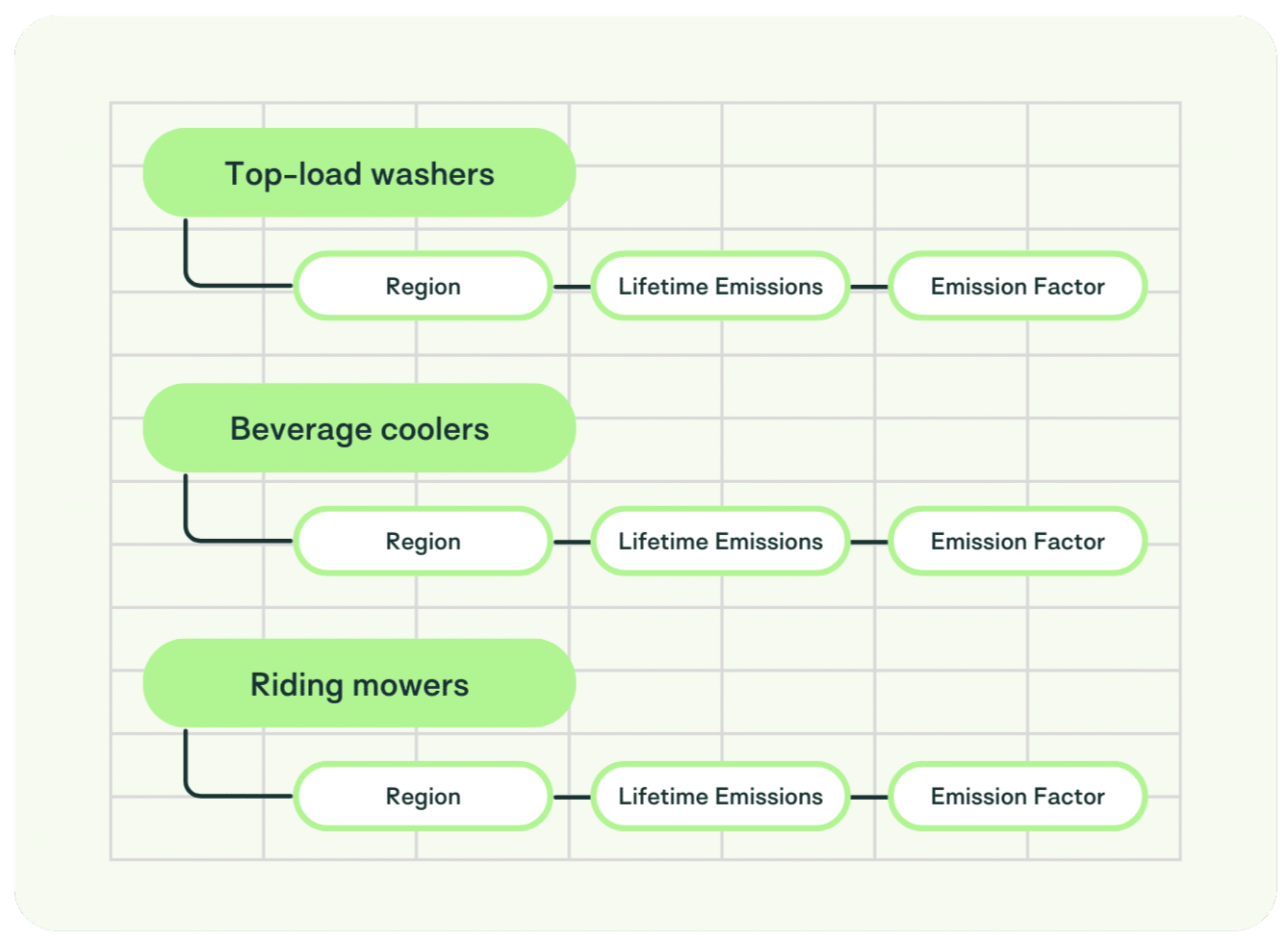
DPED has three separate dimensions with seven total classification parameters:
Two for the intended sector the product is sold:
- General industry: general consumer, commercial, or industrial
- Specific market: home & offices, entertainment, lawn & garden, etc.
Four levels of product categorization, from broad to specific:
- Product class (ex. appliances, equipment, lighting, electronics, etc)
- Product family (ex. small appliances, power equipment, outdoor cooking, etc.)
- Product category (ex. freezers, grills, water heaters, vacuums, thermostats, etc.)
- Product type (ex. trail mowers (lawn mower), top-load (clothing washer), beverage cooler (refrigerator), etc.)
One for the specific fuel type the product uses (electricity, natural gas, kerosene, dual-fuel, etc.)
What product categories are included?
DPED is designed to cover direct-use product emissions, so it covers product categories that directly consume electricity or fuel. A diverse committee of retailers has determined the most relevant and appropriate categories to include.
What industries, markets, and sectors does the database cover?
Most of the DPED focuses on general consumer products (residential, home, and office), but some commercial products are represented. A commercial classification includes products specifically designed for the scale of commercial and industrial customers, like a large walk-in freezer or heating a large construction site.
Does the tool include both Energy Star and non-Energy Star products?
Yes, each Energy Star product is differentiated from its non-Energy Star counterpart, and many products have entries for both. Products that don't directly state their Energy Star status are also categorized.
What if my products aren't exactly represented?
We have incorporated as many possible products from a selection of retailers to get as comprehensive a distribution of products as possible. Each year, we will collect feedback to expand to additional products and product categories in future iterations.
What is the geographic distribution of the database?
Global figures are provided, but there is greater granularity and data quality for product usage in the U.S. and Canada. Local emissions factors will be utilized when the specific location is given and will default to average values when the location is not provided.
How is the database kept up to date?
DPED is updated on an annual basis to account for new emission factors, assumptions, new product lines, and updated methodologies. Any changes to DPED will be logged so that year-over-year changes can be clearly identified.
Is the tool transparent about any assumptions, methodologies, and data sources being made?
Yes, the sources of emission factors, assumptions, methodologies, formulae, etc. will be documented and made available to all users. We will not, however, divulge proprietary or other confidential information.
How can you ensure the accuracy and reliability of the final factors and resulting information?
Our carbon accounting capabilities are built on over 15 years of expertise from Optera, now part of Green Project, which has helped some of the world’s largest organizations measure, calculate, and reduce their Scope 1, 2, and 3 emissions.
All emission factors and global warming potentials come from reputable sources. Emission methodologies adhere to the strictest standards for GHG accounting, life-cycle analysis, and energy-use calculation.
When direct industry and brand-specific assumptions are unavailable, they are researched according to a hierarchy of primary, secondary, and other sources to ensure the best available data is used.
A data quality index (DQI) is employed to log the reliability of each data point, allowing us to go back and easily improve database assumptions as better data is made available.